
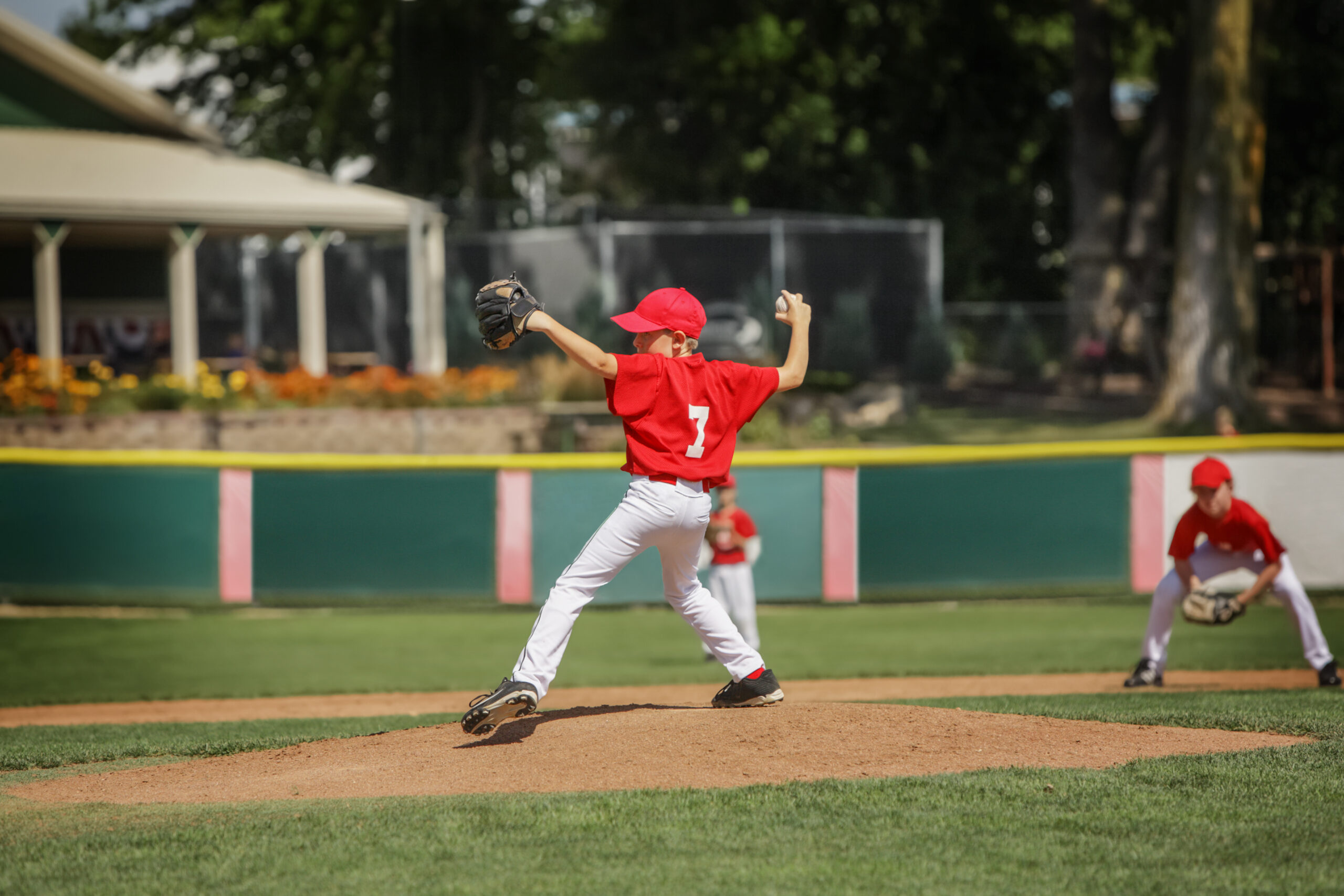
Many parents of young baseball players have heard warnings about pitching too much, throwing year-round, or specializing too early. When it comes to youth baseball pitching, there is often confusion about what helps young athletes develop safely and what may increase injury risk.
These concerns are valid. Overuse injuries remain one of the biggest risk factors for youth baseball injuries.
However, there is another side of the conversation that often gets overlooked.
Research suggests that appropriately managed youth baseball pitching may help young athletes develop important physical adaptations that support both performance and shoulder health later in their careers.
The key is not avoiding pitching altogether. The key is helping young athletes participate in youth baseball pitching safely, progressively, and within recommended workload guidelines.
At STL Physical Therapy, we frequently work with baseball players of all ages through our baseball physical therapy program to help them improve mobility, maintain shoulder health, and stay available throughout the season.
Why Throwing Places Unique Demands on the Shoulder
Baseball pitching requires some of the most extreme movements found in sports.
During the late cocking phase of the pitching motion, the shoulder externally rotates to an extraordinary degree. Research has shown that pitchers can routinely exceed 165 degrees of external rotation during a throw. For comparison, a non-throwing adult typically demonstrates around 90 degrees of external rotation.
To achieve these positions safely, the shoulder must balance two competing demands:
- Enough mobility to achieve proper layback
- Enough stability to keep the shoulder joint centered and controlled
Over time, the body adapts to these demands.
These adaptations are one reason why a youth baseball pitcher often looks and moves differently than a non-throwing athlete.
How the Throwing Arm Changes Over Time
One of the most consistent findings in baseball research is that throwing athletes develop more external rotation in their throwing arm.
Studies have shown that baseball players often gain additional external rotation while losing a small amount of internal rotation compared to their non-throwing arm.
Years ago, physical therapists often viewed this loss of internal rotation as a problem that needed to be corrected aggressively.
Today, we understand that many of these changes are actually normal adaptations to throwing.
In many cases, the total amount of shoulder rotation remains relatively unchanged (i.e. shoulder external rotation + shoulder internal rotation). The motion simply shifts toward more external rotation, which helps pitchers achieve the positions needed to throw effectively.
For a youth baseball pitcher, these changes can be a normal part of athletic development when they occur gradually and within appropriate training loads.
What Is Humeral Retroversion?
One of the most important adaptations associated with youth baseball pitching is a structural change known as humeral retroversion.
Humeral retroversion refers to the orientation of the upper arm bone, or humerus. As young athletes grow and continue throwing, the throwing arm may develop slightly different characteristics than the non-throwing arm.
This adaptation helps explain why many baseball players naturally develop more external rotation in their throwing shoulder.
Importantly, this does not necessarily mean the shoulder becomes looser or unstable. Instead, the orientation of the bone changes over time, allowing pitchers to achieve the arm positions needed for throwing without relying entirely on the soft tissues around the shoulder.
Researchers have found that baseball pitchers often gain external rotation while losing a similar amount of internal rotation. When total shoulder motion is measured, however, the overall range of motion is often very similar between arms.
This is one reason humeral retroversion is considered a normal adaptation to throwing rather than a problem that needs to be corrected.
For a developing baseball player, these changes may help support both throwing performance and shoulder health when they occur naturally throughout the growth process.
How Youth Baseball Pitching Influences Growth and Development
One of the most interesting findings from baseball research is that these structural changes appear to develop during childhood and adolescence.
As children grow, the humerus naturally changes position over time. At birth, children typically have a high degree of humeral retroversion, often around 65 degrees. As they grow, that number gradually decreases, reaching approximately 38 degrees by age 11 and eventually settling around 25 to 30 degrees in adulthood.
Research suggests that repetitive throwing may influence this process by slowing some of the normal changes that occur during growth. The result is a greater difference between the throwing and non-throwing arm, helping young athletes develop the adaptations commonly seen in pitchers.
Importantly, these adaptations appear to occur before skeletal maturity. Once growth plates close, the opportunity for these structural changes becomes much more limited.
This finding has important implications for young baseball players. Because these adaptations develop while the body is still growing and are largely complete by late adolescence, waiting until high school or later to begin throwing may limit an athlete’s ability to develop some of the natural adaptations that support pitching performance and shoulder health.
This does not mean young athletes should throw excessively. Rather, it highlights the importance of participating in youth baseball pitching within safe, age-appropriate guidelines throughout childhood and adolescence.
Can Youth Baseball Pitching Improve Performance?
The goal is never to encourage excessive pitching or year-round specialization.
However, appropriate youth baseball pitching exposure may help athletes develop physical qualities that support future performance.
Greater humeral retroversion has been associated with increased external rotation during the pitching motion.
This increased range of motion may allow pitchers to create a longer throwing arc, giving them more time to accelerate the arm before ball release.
More time to accelerate the arm can contribute to greater throwing velocity.
For a developing youth baseball pitcher, these natural adaptations may support performance gains over time when combined with proper strength training, mobility work, and throwing mechanics.
What About Injury Risk?
This is where the conversation becomes more nuanced.
Many parents assume that avoiding pitching altogether will reduce injury risk.
The research suggests the answer is more complicated.
Some studies have found that pitchers with lower amounts of humeral retroversion may experience higher rates of baseball shoulder injuries and shoulder problems over time. One reason may be that they have to rely on soft tissues such as the shoulder capsule, labrum, and rotator cuff to achieve the range of motion required for pitching.
Athletes who develop appropriate throwing adaptations may place less stress on these structures.
At the same time, more is not always better.
Greater humeral retroversion has also been associated with increased stress at the elbow, particularly on the ulnar collateral ligament (UCL).
This highlights an important reality about baseball development.
There is rarely a single factor that determines whether an athlete stays healthy.
Instead, injury risk is influenced by a combination of:
- Throwing volume
- Recovery strategies
- Strength levels
- Mobility
- Pitching mechanics
- Seasonal workload
- Overall athletic development
Why Workload Management Matters in Youth Baseball Pitching
The findings on youth baseball pitching should not be interpreted as encouragement to throw year-round.
Pitch count guidelines and recovery recommendations remain essential.
Young athletes still need:
- Scheduled rest periods
- Age-appropriate pitch counts
- Multiple-sport participation when possible
- Proper strength and conditioning
- Ongoing monitoring of shoulder and elbow health
The goal is exposure, not overexposure.
A well-designed throwing program allows athletes to develop the adaptations that support performance while minimizing unnecessary stress on the arm.
How Physical Therapy Helps Youth Baseball Players
Many baseball players do not seek physical therapy until pain develops.
However, physical therapy can play an important role in injury prevention and performance long before symptoms appear.
At STL Physical Therapy, baseball evaluations often include:
- Shoulder range of motion testing
- Total rotational motion assessment
- Scapular movement evaluation
- Strength testing
- Mobility assessment
- Throwing-related movement analysis
- Balance
- Coordination
- Areas of pain or restriction
- Injury history
- Performance goals
These assessments help identify potential limitations before they become bigger problems.
For a youth baseball pitcher, maintaining the right balance between mobility, stability, strength, and recovery is often the difference between staying healthy and spending time on the sidelines.
The Bottom Line
Should you delay your child’s youth baseball pitching career?
Current research suggests that completely avoiding pitching during childhood may not provide the benefits many people assume.
When managed appropriately, youth baseball pitching can help young athletes develop important adaptations that support both throwing performance and shoulder health.
The focus should not be on delaying pitching. The focus should be on developing pitchers safely.
Appropriate workloads, proper recovery, strength training, mobility work, and regular monitoring can help young athletes continue to enjoy the game while reducing their risk of injury.
Schedule a Youth Baseball Pitching Evaluation
If your child participates in youth baseball pitching and you want to better understand their shoulder mobility, strength, recovery, or injury risk, the team at STL Physical Therapy can help.
Our baseball-specific evaluations are designed to assess movement, identify limitations, and create individualized plans that support long-term development.
Contact STL Physical Therapy today to schedule a youth baseball pitching evaluation and help your athlete stay healthy, throw efficiently, and continue progressing throughout their baseball career.
Whether your child is just beginning their baseball journey or is preparing for higher levels of competition, understanding how their body is adapting to the demands of throwing can help support both performance and long-term arm health.