
If you teach golf, you have seen this happen more times than you can count. You give a student a clear, simple fix. Turn a little more going back. Keep the trail hip from sliding. Hold your posture through impact. They nod, they understand it, and then they cannot do it. Not because they are not listening, but because their body will not let them. That gap is exactly where a golf physical therapist fits in, and we want to be clear about one thing right up front: we are not trying to be swing coaches.
At STL Physical Therapy, our job is the body behind the swing, and our goal is collaboration, not competition. We hope this post helps to explain who we are and what we do when a golfer enters our facility.
What a Golf Physical Therapist Does (and What We Don’t)
The simplest way to explain it is to lay both sides out next to each other.
What we do:
- Assess how a golfer’s hips, upper back, shoulders, and core move
- Find the mobility, strength, or stability limits that are holding their body back
- Treat the pain that keeps people from practicing or finishing a round
- Build a plan that helps them create power efficiently and safely
What we don’t do:
- Teach grip, setup, alignment, or swing path
- Work on chipping, putting, or shaping shots
- Rebuild, reinvent, or “fix” anyone’s swing
- Give golf lessons
When one of our clients asks us how to stop slicing the ball, the answer is easy: “We would love to send you to one of our trusted golf instructors to have them take a look.” A golf physical therapist makes sure the body is ready for the work. The instructor decides what that work looks like.
The Three Tiers of Golf Performance
Our physical therapists use a simple three-tier model to explain how we think about golf performance. It is the clearest way we know to show how physical therapy and golf instruction fit together without stepping on each other.
The Golf Performance Pyramid
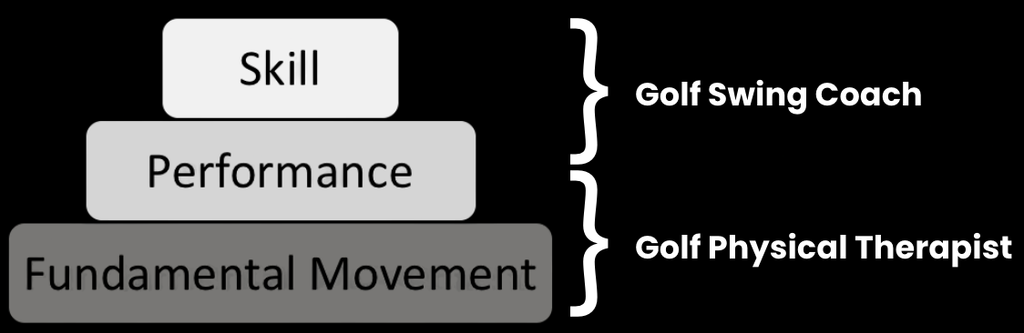
Fundamental Movement (The Base)
This is our wheelhouse. Does the golfer have the requisite mobility to hinge, rotate, and remain balanced as they move through basic patterns required by the golf swing without pain? At a foundational level, we discover these movement restrictions, identify painful triggers, and create a plan to improve fundamental movement patterns. This can include manual therapy techniques such as dry needling, soft tissue massage, and joint manipulation as well as corrective exercises that prioritize mobility and stability.
Performance (The Middle)
This is where our professions overlap. Can the golfer generate power efficiently and safely? In the physical therapy setting, we address these key issues through medicine ball training and strength training to ensure the proper strategy is being used to produce rotational power. This is also where we build capacity so our golfers remain healthy throughout their rounds and season. For a golf instructor, this tier may look slightly different. In our experience, we have observed golf instructors using the art of coaching cues to produce the desired sequence of events leading to a fluid golf swing. Two different strategies with the same goal in mind.
Skill (The Top)
This is your world. Chipping, putting, shot-shaping, swing mechanics, course management, and all the touch and feel that turns a capable body into a good golfer.
Neither tier replaces the other. A golfer with great instruction and a stiff, limited body is going to hit a ceiling. And a strong, mobile golfer without good instruction is really just a strong, mobile person holding a golf club. The best results come when both tiers are being worked on by people who know their lane.
Our Proven Process
Our team has worked with athletes at every level, and collaborating with skill coaches is not only extremely beneficial for their development but also a system we are very familiar with. Collaborating with baseball coaches is one example.
Baseball players typically get sent our way after a throwing injury involving the elbow or shoulder. To start, we perform a detailed movement assessment to see where they may be limited from a mobility or strength standpoint. Next we create a plan to clean up these limitations and improve their throwing efficiency. While the goal of our treatment is to decrease pain, we frequently see an increase in velocity.
As our baseball players approach their return to the field, we communicate with their pitching instructors our movement findings and work in collaboration to create a throwing program that fits each athlete we are working with. We know every athlete is different, which is why each program is individualized and specific.
We don’t focus on pitching mechanics, pitch grip, or pitch sequence. We hone in on movement quality and pain control. Golf works the same way. We help build the engine, and then the skill instructor helps to fine-tune it.
When the Body Sets the Ceiling on the Swing
Here is the example we come back to most.
Say you tell a student to rotate further into their backswing. It is a reasonable task and a common one. But if that golfer does not have the hip or thoracic mobility to make that turn, no amount of practice is going to get them there. They can hit balls all week and still come up short.
Usually, their body will try to find the motion somewhere else. The hips slide instead of turning. The spine side bends. The arms lift to fake a bigger turn. Often, the low back ends up picking up the slack.
The research lines up with what we see in the clinic. The Titleist Performance Institute describes the body-swing connection this way: there is no single perfect swing, but each player has an efficient swing based on what their body can physically do, and physical limitations can hurt the swing and potentially lead to injury. A study of professional golfers with low back pain found they had less lead hip internal rotation than golfers without pain.
That is where a golf physical therapist can help. Our role is to remove that physical ceiling so the golfer can actually execute what you are asking for. We find the restriction, treat it, build the strength to use the new range of motion, and then retest to make sure it stuck. When your student comes back to the lesson tee, the turn you asked for is finally available to them.
How We Work With Golf Instructors in St. Louis
We know trust gets built through actions. So here is how we approach it when a golfer who works with an instructor comes to see us.
We stay in our lane. We will not critique your student’s swing or contradict your instruction. If a client asks us a technique question, we refer to your expertise.
We speak in movement terms. With our client’s permission, we are happy to share what we found, like limited lead hip rotation or a stiff upper back, so you know what their body can and cannot do right now. That can help you decide what to work on while their body catches up.
We point golfers toward good instruction. If a client tells us they want to improve their swing and they do not have a coach, we send them to a trusted professional in our network. Getting a body ready to move better only pays off when someone skilled is teaching what to do with it.
We show our work. Our golf movement assessment gives us objective numbers we can measure today and retest a few weeks later. Your student does not have to take our word for it, and neither do you.
Signs a Student Might Benefit From a Golf Physical Therapist
You are often the first person to notice when something physical is getting in the way. A few common signs:
- They understand the change you are teaching but cannot get into the position no matter how many reps they put in
- They mention low back, hip, shoulder, elbow, or wrist pain after practice or a round
- They are losing speed or distance without any obvious change in their technique
- Their swing looks different on the back nine than it did on the first tee
- They sit at a desk most of the day and have lost rotation over the years
None of these mean something is wrong with the golfer. They just mean the next step might be physical rather than technical.
What Our Golf Movement Assessment Measures
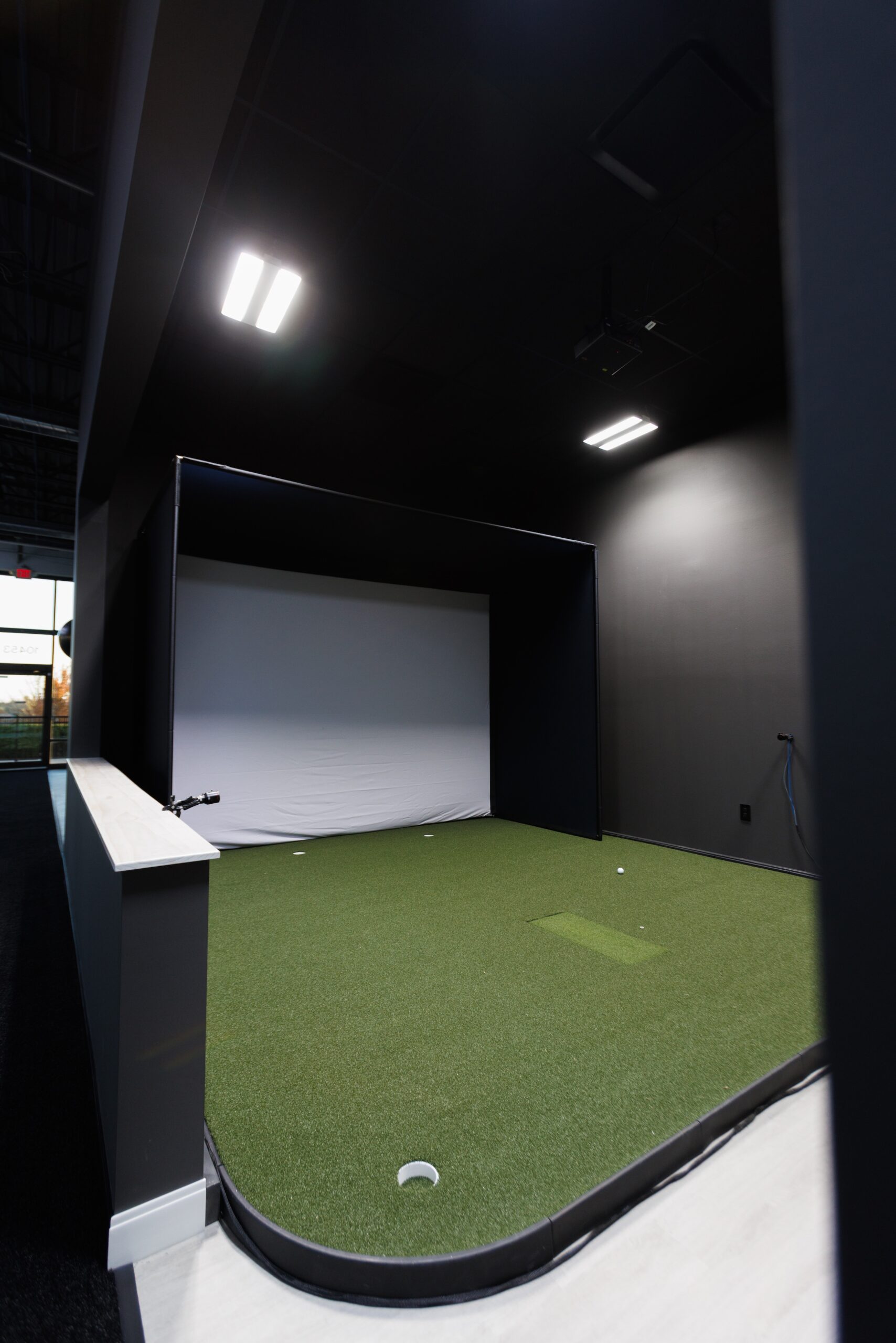
Our new golf simulator is not a launch monitor, and it is not a lesson. We are not paying much attention to ball flight or smash factor. We are looking at the person swinging the club: how their body sequences power from the ground up and how well their pelvis and upper back rotate through the swing.
If you want the deeper dive, our post on kinematic sequence in golf walks through exactly what the simulator shows and how we use it to build a plan.
Frequently Asked Questions
Is a golf physical therapist the same as a golf fitness trainer?
There is overlap, and good trainers do great work with golfers. The difference is that a golf physical therapist is a licensed clinician who can evaluate and treat pain and injury, as well as work on mobility, strength, and power for performance.
Will a golf physical therapist change my student’s swing?
No. We do not teach technique or change swing mechanics. We work on the mobility, strength, and power the body needs so your student can execute the swing you are teaching.
Does a golfer need to be hurt to see a golf physical therapist?
No. Plenty of golfers come to us because they have lost distance, feel stiff, or cannot make a change their coach is asking for. Others come in for pain. Many come in for both.
How do you communicate with a student’s golf instructor?
Only with our client’s permission. When they are comfortable with it, we can share what we found in plain movement terms so everyone is working from the same picture.
How long does it take to see a change?
Every golfer is different. We typically see a measurable change when we retest in the simulator about three weeks after the first evaluation, so both the golfer and their coach can see what has changed and what to focus on next.
Let’s Work Together: A Golf Physical Therapist in Your Corner
We see ourselves as part of your student’s team, not a replacement for anyone on it. You coach the swing. We make sure the body can deliver it. When both sides do their part, golfers play better, practice with less frustration, and stay on the course longer.
If you are a golf instructor or teaching pro in St. Louis, we would love to meet you, show you our new space, and walk you through what our golf movement assessment looks like in person. And if you have a student who keeps running into the same physical wall, send them our way. We will help their body catch up, then send them right back to you ready to work. Reach out to connect with our golf physical therapist team, and let’s start the conversation.